GEO guide
Brand Brain vs. Brand Book: What Actually Changes When AI Reads Your Brand
TL;DR
A brand book documents how your brand looks — logo, palette, fonts, maybe a tone paragraph — for a human designer to reference by hand. A brand brain documents how your brand thinks and talks — voice patterns, customer language, offer detail, standard answers — structured so an AI tool can read it and produce on-brand output without a human translating first. They solve different problems: a brand book keeps your visuals consistent; a brand brain keeps your AI-generated words and decisions consistent. Most businesses that already use AI to write, design, or answer customers need both, because a brand book alone cannot stop AI from sounding generic.
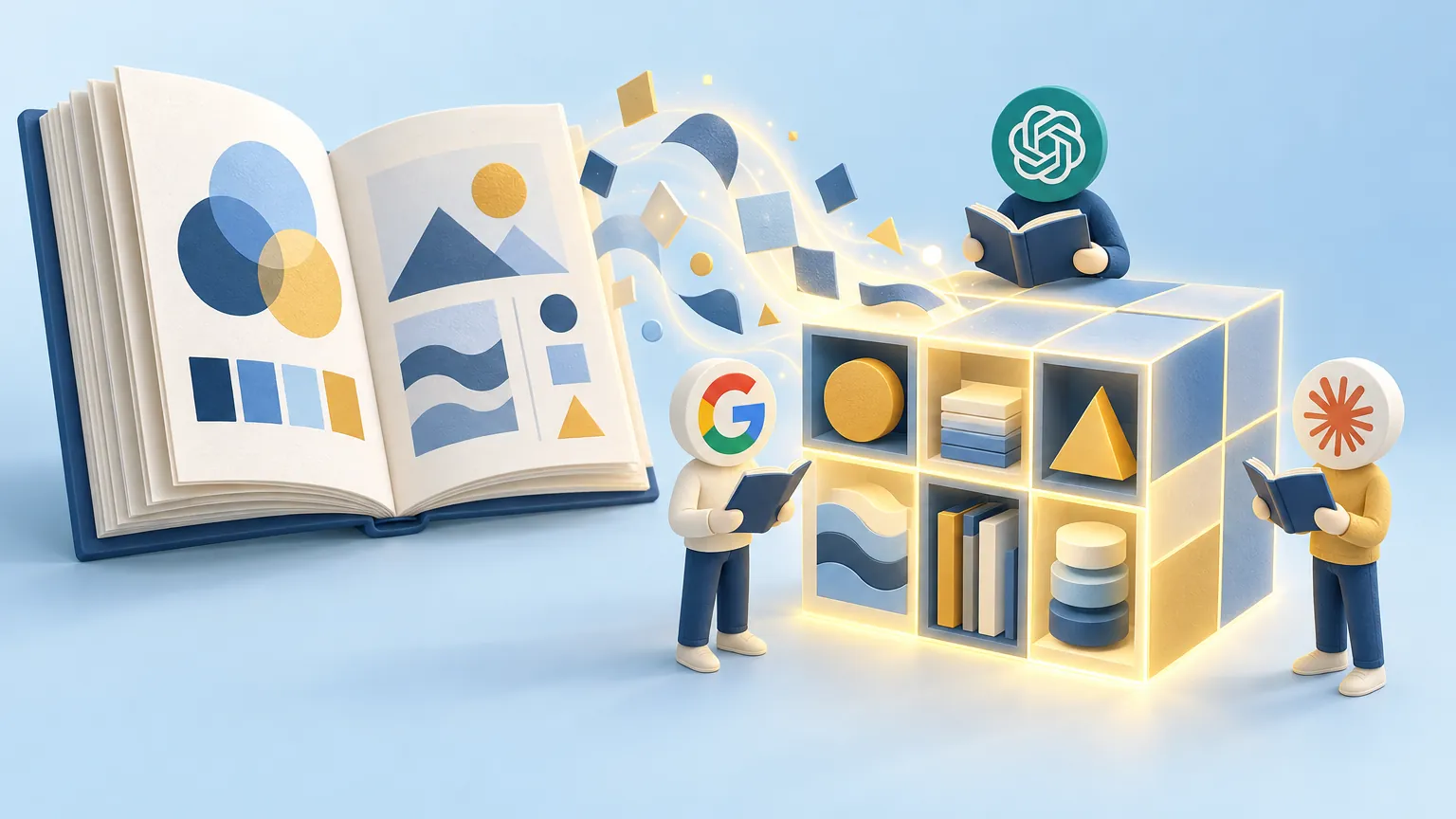
A brand book documents how your brand looks. A brand brain documents how your brand thinks and talks — in a format AI can actually read. They are not competing documents; they cover different ground, and confusing one for the other is why so many businesses have a polished visual identity and still get generic, off-voice copy out of ChatGPT or Claude.
What is a brand book, exactly?
A brand book (also called brand guidelines or a style guide) is a reference document — usually a PDF — built for one purpose: keeping your visual identity consistent when a human designer touches it. It typically covers logo usage and clear space, an approved color palette with hex codes, typography rules, and sometimes a short section on tone of voice, often three or four adjectives with no real examples.
That last part is the tell. Brand books were written in an era when the main risk to a brand was a designer using the wrong blue or stretching the logo. They were never built to answer the question a business now actually has: how do I make an AI tool write and design like my brand, not like a generic template?
What does a brand brain add?
A brand brain includes the brand book's visual rules, but its real bulk is elsewhere — the areas a visual-only document leaves blank:
- Brand book covers it?
- Yes
- Brand brain covers it?
- Yes (inherited)
- Brand book covers it?
- Rarely
- Brand brain covers it?
- Yes
- Brand book covers it?
- No
- Brand brain covers it?
- Yes
- Brand book covers it?
- No
- Brand brain covers it?
- Yes
- Brand book covers it?
- No
- Brand brain covers it?
- Yes
- Brand book covers it?
- No (locked PDF)
- Brand brain covers it?
- Yes (plain text)
| Area | Brand book covers it? | Brand brain covers it? |
|---|---|---|
| Logo, color, typography | Yes | Yes (inherited) |
| Voice patterns from real writing | Rarely | Yes |
| Customer's exact language for their problem | No | Yes |
| Offer detail (price, tiers, exclusions) | No | Yes |
| Standard answers to objections | No | Yes |
| Format AI tools can parse directly | No (locked PDF) | Yes (plain text) |
The pattern: a brand book answers "does this look right," a brand brain answers "does this sound right and say the right thing." AI tools do not struggle with color codes — they struggle with voice, offer accuracy, and knowing what not to promise, which is exactly the material a brand book was never asked to hold.
Why AI changes the requirement
Before AI wrote first drafts, a brand book was often enough, because a human copywriter who already knew the business filled the gaps a style guide left. That gap-filling does not happen automatically with AI. A tool with no brand context defaults to generic marketing language — competent, but indistinguishable from every other business in your category. It cannot invent your customer's real objections or your actual pricing structure from a logo file.
This is also the practical foundation of GEO (Generative Engine Optimization): the same structured, plain-text, answer-first material that helps an AI tool write on-brand copy is what helps AI search engines cite a brand accurately when they do reference it. A brand brain and GEO-ready content draw from the same source material.
What the difference looks like in a real prompt
Picture asking an AI tool to write a landing page paragraph for a local service business. With only a brand book behind it — logo, colors, three tone adjectives — the AI has the visual constraints right but has to guess everything else: it invents a generic value proposition, picks a price range out of thin air, and answers objections nobody actually raises. The paragraph reads fine, but it could belong to any competitor with the same three adjectives.
Feed the same prompt a brand brain — real pricing, the customer's actual words for their problem, the objection they raise most, three sentences pulled from the founder's real writing — and the guessing stops. The AI is not being more creative with a brand brain in place; it has less to invent, which is exactly why the output sounds specific instead of generic. That gap is the entire case for building one.
Do you need both, or just one?
Most small businesses that already use AI for writing, design, or customer answers need a brand brain regardless of whether they have a formal brand book. A few situations split differently:
- No visual identity yet. Build the visual rules first — a brand brain without a defined look has nothing to encode on that front.
- Established visual identity, but no one has written down voice, offer, and customer language as text. This is the most common gap. The brand book exists; the brand brain does not.
- Multiple locations, franchise partners, or outside vendors touching your visuals. Keep the formal brand book for that audience — it does a job a text file cannot.
A brand brain does not need to be a separate initiative from your brand book — it can absorb it, adding the voice, offer, and customer sections a visual guide was never meant to carry.
The honest limit
No one can promise a brand brain, a brand book, or any single document gets an AI engine to recommend your business — be skeptical of anyone who claims otherwise. What a brand brain does is make your brand legible: consistent enough that when AI does generate copy for you, or answer a question about you, the output is recognizably yours instead of a template with your logo pasted on top.
If you want to see where your own brand currently stands on this, cerebrodemarca.com runs a free Memory Score that checks your actual digital footprint against the six areas a brand brain needs — ten free scores run each month. If you already know you need the full build, not just the diagnosis, the Gugubrand AI Brand Algorithm is the paid version of this work, done for you.
- Cerebro de Marca
- Brand Brain
- Brand Book
- Manual de Marca
- Branding
- AI Brand Algorithm
Frequently asked questions
Is a brand brain just a fancier name for a brand book?
No — they cover different material. A brand book is almost entirely visual: logo usage, color codes, typography, spacing rules. A brand brain includes visual rules too, but its bulk is things a brand book rarely writes down at all: voice patterns pulled from real copy, the exact words customers use for their problem, offer details down to price and what is excluded, and standard answers to common objections. A brand book tells a designer what not to break. A brand brain tells an AI tool what to say.
Can I skip the brand book and go straight to a brand brain?
Yes, for most small businesses. If nobody outside your team touches your visual files — no outside printers, no franchise partners, no large design team — a brand book is often more formality than function. A brand brain still needs your visual identity as one of its inputs, but it can live as one section of a working text file instead of a separate 40-page PDF. The exception is any brand that licenses its identity out or manages many locations, where a formal brand book earns its keep.
Does a brand brain replace my designer or brand agency?
No. A brand brain feeds AI tools so their first draft is closer to on-brand — it does not replace the judgment that decided what your brand should look and sound like in the first place. The strategic work (positioning, visual identity, messaging architecture) still needs a human or an agency to define it well. A brand brain is what happens after that work exists: turning it into a format AI can actually use.
How is a brand brain different from just pasting my brand book into ChatGPT?
Pasting a brand book in is a start, but most brand books were never written for that use — they describe colors and logo spacing, not voice patterns or customer language, so the AI still has to guess at the parts that make copy sound like you instead of like a template. A brand brain is written specifically to be read by AI: structured, text-first, and covering the areas — voice, offer, customer, messaging, visual, content — that a visual-only brand book leaves blank.
Will having a brand brain get AI to recommend my business?
No one can honestly promise that, and be wary of anyone who does. What a brand brain does is make your brand legible — consistent, specific, easy for AI to represent accurately when it does answer a question about you. Whether an AI engine chooses to cite or recommend you depends on factors no single document controls, including how visible your brand is across the wider web.