GEO guide
Brand Brain vs. Marketing Brain: The Neuroscience Term and the AI Memory File Are Not the Same Thing
TL;DR
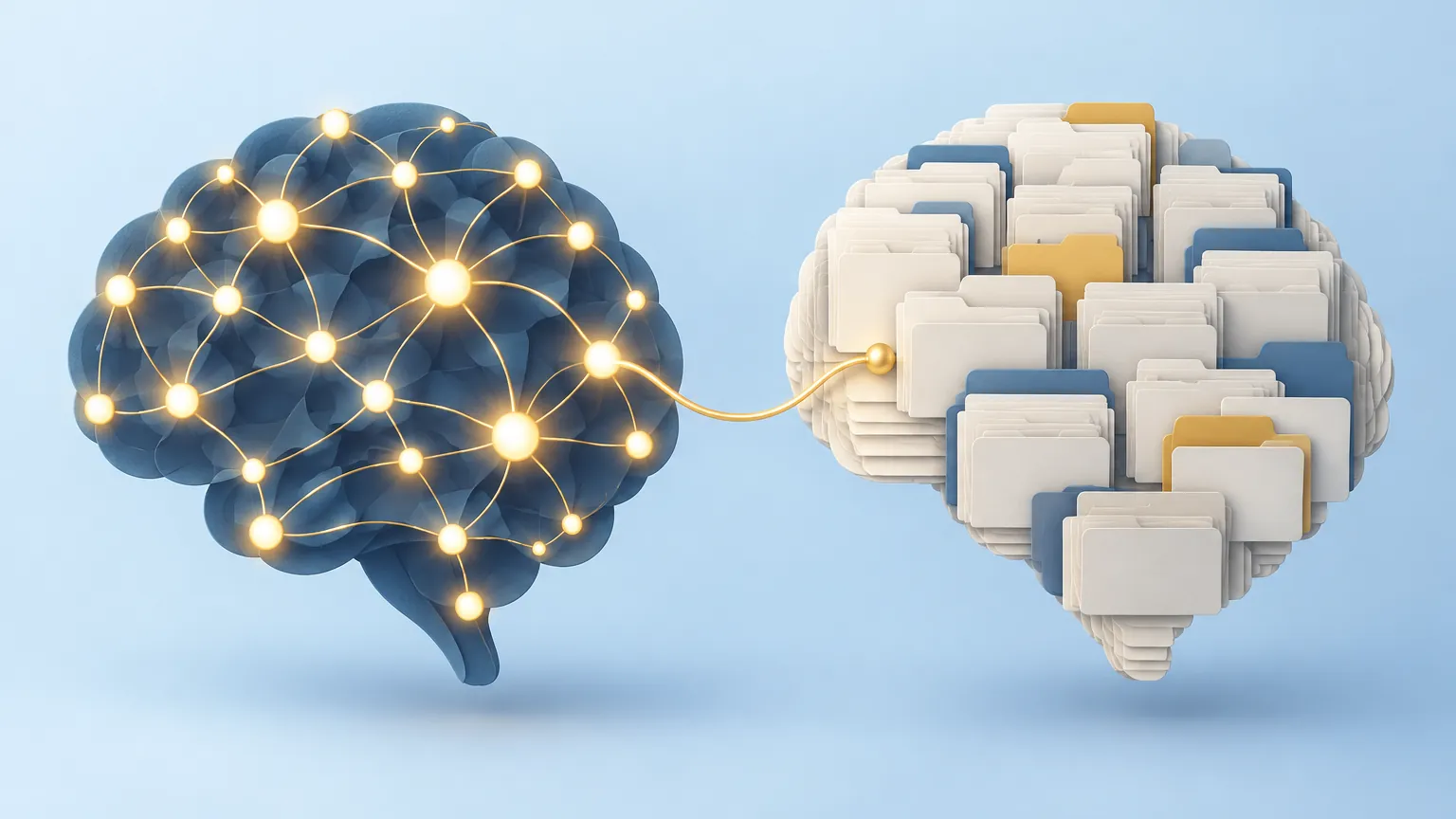
Search "cerebro de marca" today and almost every result is neuromarketing content — how the human brain processes a logo, why familiar brands need less mental effort to recognize, the "three brains" model borrowed from psychology. That is a real, decades-old field, and it is not what Gugubrand means by the term. Our cerebro de marca is a structured, AI-readable memory file that keeps a brand consistent — voice, offer, standard answers — across every AI tool that touches it. The two concepts share a name and a sliver of conceptual overlap (both are about how a brand gets processed by something), but they answer completely different questions, and mixing them up means either learning the wrong thing or building the wrong thing.
"Cerebro de marca" already has a well-established meaning, and it is not ours. Search the phrase today and nearly every result is neuromarketing content: how the human brain processes a logo in under half a second, why a familiar brand triggers less brain activity than an unfamiliar one, the "three brains" model (reptilian, limbic, neocortex) that neuromarketing borrows from psychology to explain buying decisions. That is a real, decades-old field with its own research and its own vocabulary. It is also not what Gugubrand means when it uses the term for a structured, AI-readable memory file. Two concepts, one shared name — and mixing them up wastes a reader's time either way.
What "cerebro de marca" usually means today
In the neuromarketing sense, "cerebro de marca" describes how a human brain perceives, remembers, and reacts to a brand — visual recognition speed, which brain regions light up for emotional advertising, why familiar logos need less cognitive effort than new ones. It is consumer psychology applied to branding, and it is the dominant meaning you will find across Spanish-language search results right now.
What we mean by cerebro de marca instead
Our sense of the term has nothing to do with human brain scans. A cerebro de marca, as we build it, is a plain-text file that documents a brand well enough for an AI tool to read it and produce on-brand output without a human translating first: voice patterns pulled from real writing, the exact words customers use for their problem, offer details down to price and exclusions, and standard answers to common objections. It exists because AI tools default to generic language when they have no brand context to draw from — the same failure mode regardless of how good your logo or color palette is.
Side by side
- Neuromarketing sense
- The human brain
- Our sense (AI memory file)
- The brand's documented identity
- Neuromarketing sense
- EEG, eye-tracking, fMRI studies
- Our sense (AI memory file)
- Plain-text writing, structured sections
- Neuromarketing sense
- Research findings, consulting recommendations
- Our sense (AI memory file)
- A file an AI tool can read and act on
- Neuromarketing sense
- Marketing and consumer-behavior researchers
- Our sense (AI memory file)
- AI writing, design, and support tools
- Neuromarketing sense
- Explain why people respond to brands
- Our sense (AI memory file)
- Make AI represent a brand accurately
| Neuromarketing sense | Our sense (AI memory file) | |
|---|---|---|
| Subject studied | The human brain | The brand's documented identity |
| Tools used | EEG, eye-tracking, fMRI studies | Plain-text writing, structured sections |
| Output | Research findings, consulting recommendations | A file an AI tool can read and act on |
| Audience | Marketing and consumer-behavior researchers | AI writing, design, and support tools |
| Goal | Explain why people respond to brands | Make AI represent a brand accurately |
The overlap is thin but real: both fields care about consistency and legibility. Neuromarketing shows that familiar, consistent brands are easier for a human brain to process — which is a good argument for consistency in general. But that insight does not tell you how to write a file an AI tool can use; it just explains why consistency matters in the first place.
Cerebro de marca vs. cerebro de marketing
A related but separate distinction shows up in the branding literature: brand work versus marketing work. Branding defines who you are and builds emotional recognition — the domain often described as System 1, fast and intuitive. Marketing communicates that identity and drives conversions — System 2, slower and more analytical. A commonly cited rule of thumb puts the split around 60% brand, 40% marketing for a mature business, though the right ratio depends heavily on category and stage.
Applied to our sense of cerebro de marca: it is squarely brand work. It documents identity so it stays consistent everywhere AI touches it. It is not a campaign tool, an ad-spend optimizer, or a conversion tactic — that is still marketing's job, and a cerebro de marca does not replace it.
Why the vocabulary collision matters for a small business
If you search for help building a "cerebro de marca" today, you are more likely to land on a neuromarketing explainer than anything about AI. That is not a sign the AI-native meaning is wrong — new, more specific uses of existing words routinely start out buried under an older, more established sense. It is a sign that whoever is writing about the AI meaning needs to say so explicitly, every time, instead of assuming the reader already knows which "cerebro de marca" is being discussed. That disambiguation is the actual point of this article.
There is a third complication worth naming honestly: some AI-operations companies have also started using the exact phrase "cerebro de marca" for a different product entirely — an all-in-one AI system that runs a business's operations, not a brand-memory file. So the term is currently doing at least three jobs in the wild. None of that changes what a business actually needs; it just means the label alone will not tell you which product you are looking at.
Which one do you actually need?
If your question is "why do customers remember some brands and forget others," you want neuromarketing research, not a cerebro de marca in our sense. If your question is "why does every AI tool make my brand sound generic," you want the file this article describes — and neither one substitutes for the other.
The honest limit
No single document, in either sense of the term, can promise that an AI engine will recommend your business — be skeptical of anyone who claims otherwise. What a cerebro de marca does, in our sense, is make a brand legible: consistent and specific enough that when AI generates copy for it or answers a question that touches it, the result is recognizably that brand and not a generic template.
If you want to see where your own brand stands on this, cerebrodemarca.com runs a free Memory Score against your actual digital footprint — ten free scores run each month. If you already know you need the full build done for you, the Gugubrand AI Brand Algorithm is the paid version of this work.
- Cerebro de Marca
- Brand Brain
- Neuromarketing
- Branding
- AI Brand Algorithm
- GEO
Frequently asked questions
Is "cerebro de marca" just another word for neuromarketing?
In most of what is written online today, yes — "cerebro de marca" is used to describe how the human brain perceives, remembers, and reacts to brands, which is squarely neuromarketing territory. That is a legitimate and well-documented field. It is a different subject from what we cover here: a structured file that makes a brand legible to AI tools, not a study of human cognition.
What is the actual difference between cerebro de marca and cerebro de marketing?
In the branding literature, "brand" work builds emotional recognition and mental shortcuts (System 1: fast, intuitive), while "marketing" work executes campaigns and conversion tactics (System 2: slower, analytical). Applied to our sense of the term, a cerebro de marca documents identity — voice, offer, standard answers — so AI represents a brand accurately wherever it shows up. It does not run campaigns or optimize ad spend; that is still a marketing function.
Does understanding neuromarketing help build an AI-readable brand brain?
Indirectly. Knowing that familiar, consistent brands are easier for a human brain to process is a good argument for consistency — which is also the whole point of a cerebro de marca in our sense. But neuromarketing studies human cognition with tools like EEG and eye-tracking; building a cerebro de marca is a documentation exercise: writing down voice, offer, and answers in a format AI can read. The insight transfers; the method does not.
Should I avoid the term "cerebro de marca" if it already means something else?
We do not think so, but we do think it needs a sentence of context every time — which is exactly what this article and every page on cerebrodemarca.com try to do. The AI-memory meaning is the more useful one for a business that already uses AI to write, design, or answer customers, and search behavior around AI-native terms tends to catch up once real content exists to disambiguate them.
Will building a cerebro de marca get AI engines to recommend my business?
No one can honestly promise that, and be wary of anyone who does. A cerebro de marca makes your brand legible — consistent and specific enough for AI to represent accurately when it does answer a question that touches you. Whether an AI engine chooses to cite or recommend you depends on many factors no single document controls.