AI Brand Algorithm
The New Digitalization: Why Your Company's Knowledge Needs Markdown, Not PDF
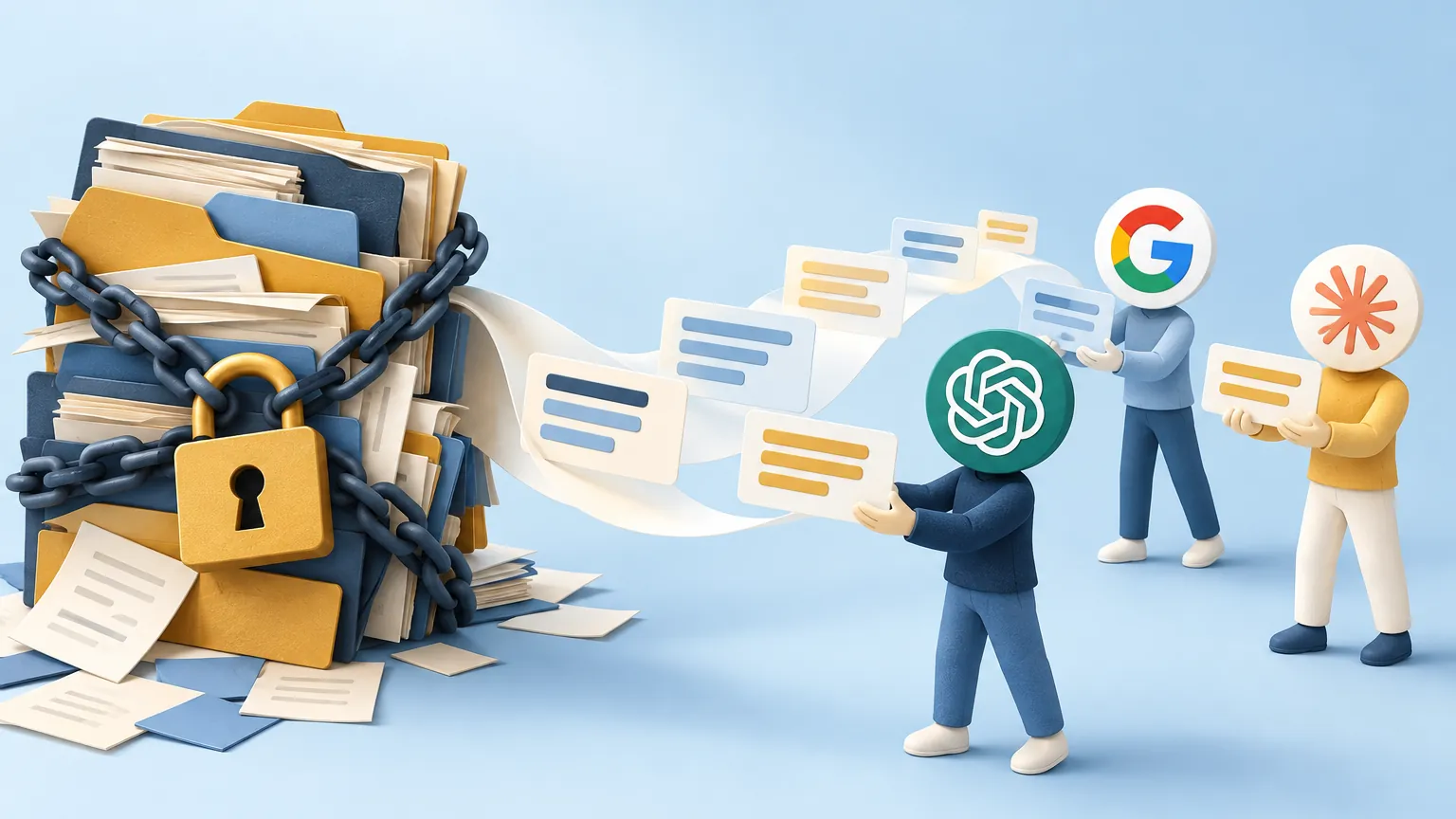
TL;DR
The first digitalization moved knowledge from paper to PDF — readable for humans, invisible to machines. The new digitalization means converting that knowledge into structured Markdown that AI can actually ingest and use. Start with a small, deliberate process: locate your knowledge, pick what matters most, convert it cleanly, link it, and keep it alive. Your AI Brand Algorithm is the safest first step.
In 2000 we turned books into PDFs. A new reader has arrived — AI — and it doesn't read the way we do.
From Filing Cabinets to Files
Around the year 2000, companies went on a scanning spree. Filing cabinets, binders, printed books — fed through a scanner one page at a time and turned into PDFs. The goal was simple, and it was right: get the knowledge off paper so it could be stored, searched, and shared without anyone walking to a cabinet. That was digitalization. It worked. Twenty-five years later we still live in those two formats — what's written, and what's in a PDF.
But something changed, and most companies haven't adjusted to it. There's a new reader in the building, and it isn't human.
AI Doesn't Read the Way You Do
When you open a PDF, your eye glides past the columns, the headers, the scanned smudges, the logo in the corner — you barely notice them. To a machine, all of that is noise it has to fight through: layout it has to decode, images it can't parse, text trapped in a format built for human eyes and laser printers. The first digitalization made your knowledge human-readable. It never made it machine-readable. Those are not the same thing.
That's the new digitalization. Not paper to PDF — documents to a format the machine actually reads well.
And that format has a name: Markdown.
Why Markdown Is the Machine's Native Language
Markdown is plain, structured text. Headings, short sections, lists, links — and nothing else. No layout to decode, no design noise, no bloat. For an AI, it's fast to ingest, easy to index, and clean enough to treat as a reliable source instead of a guess. It's becoming the native language for feeding knowledge to machines — the same way PDF became the default for handing it to people. It already runs under the surface of the tools you use every day: the docs, the wikis, the help centers, the knowledge bases AI reads from.
And when AI crawlers visit your digital presence, a well-structured llms.txt file built from that same Markdown tells them exactly what they're allowed to read and cite. If you want AI to actually use what your company knows, this is the form it needs to be in: structured, organized, and linked. We're deep in the token era — every piece of knowledge your company owns is a potential input to a machine that can act on it.
Five Steps to Start
You don't convert your whole company overnight. You start digesting your knowledge, deliberately:
- 1Find where your knowledge lives. SOPs, FAQs, your best sales emails, past proposals, the answers you repeat ten times a week. Most of it is already written somewhere — it's just scattered.
- 2Pick what matters first. Not everything. Start with the knowledge that makes you money and gets asked for most. The rest can wait.
- 3Convert it to clean Markdown. Strip the layout. Turn each piece into structured text — clear headings, short sections, plain language a machine can follow without guessing.
- 4Organize and link it. Don't leave a pile of files. Connect them — your offer links to your proof, your proof to your FAQ — so the knowledge is a map, not a heap.
- 5Keep it alive. Update it as you learn. The goal is a living source of truth, not a frozen archive that's wrong in six months.
Do this, and your company's knowledge stops being something only your people can find and becomes something your machines can use — indexed, structured, and yours.
The Safest Place to Start
Here's the honest part: doing it raw is a lot of work, and it's easy to do badly. Half-converted, inconsistent, disorganized — and the machine still can't read you. The safest way to start is to start with your brand.
That's exactly what we build first. An AI Brand Algorithm takes your brand — your concepts, your voice, your visual rules, your logos and colors, your blog posts, your reels — and digests all of it into structured, linked Markdown the AI can actually use. It's the first, safe, organized step into the new digitalization: the foundation that makes everything you publish afterward something a machine understands.
The first digitalization put your knowledge on a screen. The second one puts it in a form the machine can use. The companies that start now get a head start that's hard to catch — because while everyone else is still feeding the machine noise, yours already speaks its language.
That starts with one step.
→ Start your AI Brand Algorithm
Not sure it's your move yet? See if you're a fit in 60 seconds.
- AI Brand Algorithm
- Markdown
- GEO
- Knowledge Base
- AI for Small Business
Frequently asked questions
What is Markdown and why does AI prefer it over PDF?
Markdown is plain, structured text — headings, short sections, lists, and links with no layout or design noise. AI ingests it faster and treats it as a reliable source because the meaning lives in the structure itself, with nothing to decode around it.
Do I need to convert my entire document library?
No. Start with the knowledge that drives revenue and gets asked for most — SOPs, FAQs, key sales materials. Convert a focused, high-value core first, then expand deliberately over time.
What makes an AI Brand Algorithm the right starting point?
Your brand knowledge — voice, concepts, visual rules, content — is contained and well-defined, making it the safest knowledge set to convert first. It also becomes the foundation that makes everything you produce afterward machine-readable.